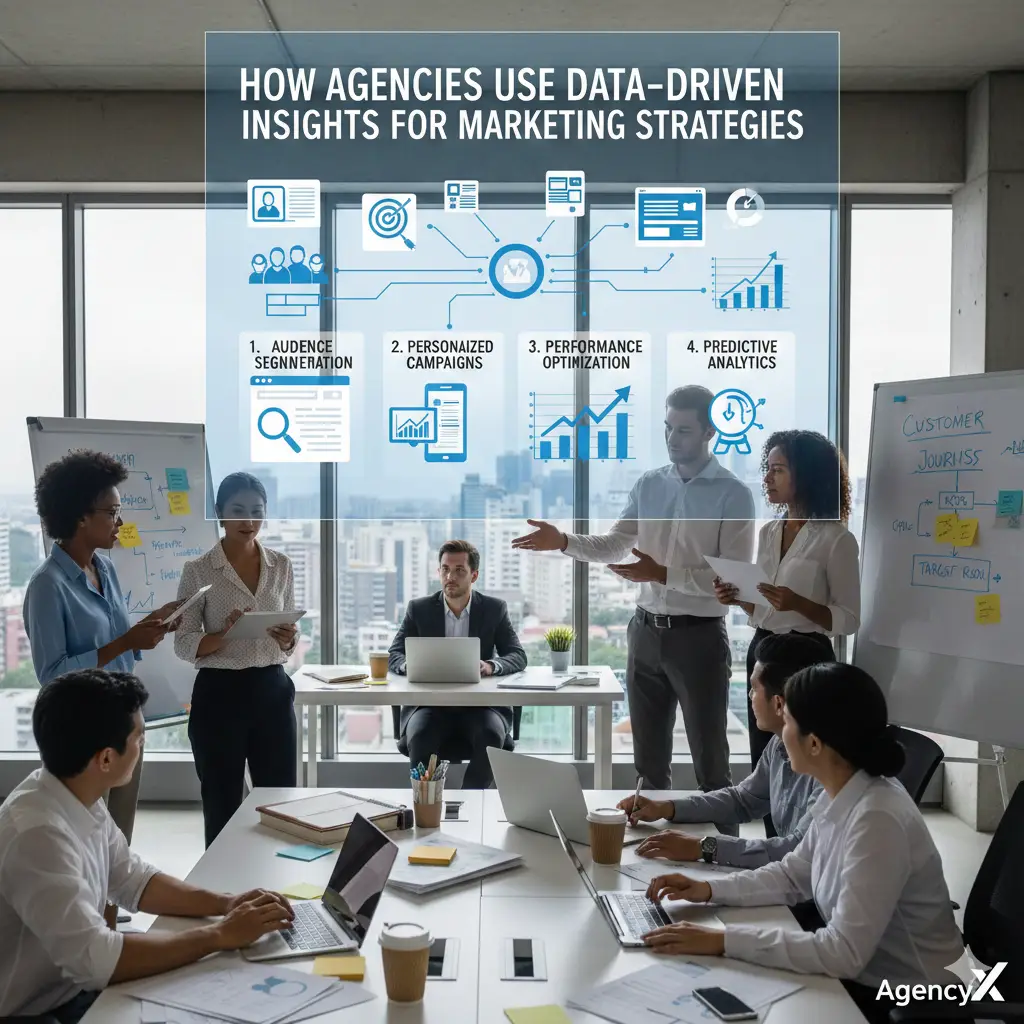
How Agencies Use Data-Driven Insights for Marketing Strategies
The world moves really fast now. Guessing does not work anymore.
The best agencies in America, England, Canada, Australia, Germany, Singapore, and other big countries all know one easy thing: Agencies that use real numbers and data to make their marketing plans are the ones who win big, the ones who don’t get left behind.
Long ago, just having “good ideas” and “nice feelings” was enough. Not anymore.
Today, every click, every scroll, every buy, and even every pause gets counted and studied. The agencies that are best at using this information make 5 to 8 times more money from their marketing. (Forrester, 2024) This article shows you exactly how leading agencies do it — step by step, tool by tool, and result by result.
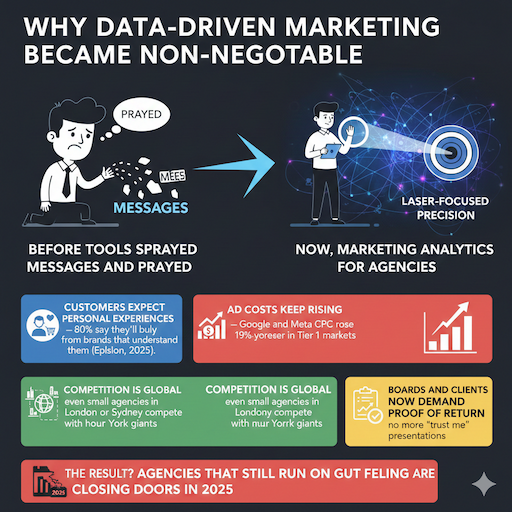
Why Data-Driven Marketing Became Non-Negotiable
Before tools existed, marketers sprayed messages and prayed. Now, marketing analytics for agencies gives laser-focused precision.
Here are the main reasons agencies switched completely:
- Customers expect personal experiences — 80% say they’ll only buy from brands that understand them (Epsilon, 2025).
- Ad costs keep rising — Google and Meta CPC rose 19% year-over-year in Tier 1 markets.
- Competition is global — even small agencies in London or Sydney compete with New York giants.
- Boards and clients now demand proof of return — no more “trust me” presentations.
The result? Agencies that still run on gut feeling are closing doors in 2025.
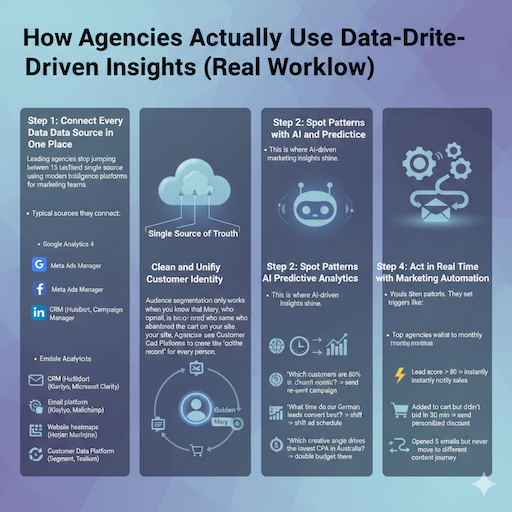
How Agencies Actually Use Data-Driven Insights (Real Workflow)
Step 1: Connect Every Data Source in One Place
Leading agencies stop jumping between 15 tabs. They build a single source of truth using modern business intelligence platforms for marketing teams.
Typical sources they connect:
- Google Analytics 4
- Meta Ads Manager
- LinkedIn Campaign Manager
- CRM (HubSpot, Salesforce)
- Email platform (Klaviyo, Mailchimp)
- Website heatmaps (Hotjar, Microsoft Clarity)
- Customer Data Platform (Segment, Tealium)
Step 2: Clean and Unify Customer Identity
Audience segmentation only works when you know that Mary, who opened your email, is the same Mary who abandoned the cart on your site. Agencies use Customer Data Platforms to create a “golden record” for every person.
Step 3: Spot Patterns with AI and Predictive Analytics
This is where AI-driven marketing insights shine.
Real examples agencies run daily:
- “Which customers are 80% likely to churn next month?” → send re-engagement campaign
- “What time do our German leads convert best?” → shift ad schedule
- “Which creative angle drives the lowest CPA in Australia?” → double budget there
Step 4: Act in Real Time with Marketing Automation
Top agencies no longer wait for monthly reports.
They set triggers like:
- Lead score > 80 → instantly notify sales
- Added to cart but didn’t buy in 30 min → send personalized discount
- Opened 5 emails but never clicked → move to different content journey
Best Analytics Tools for Marketing Agencies in 2025
Here are the tools Tier 1 and Tier 2 agencies actually pay for (updated December 2025):
| Tool | Best For | Pricing Starts |
| MotherDuck + dbt | Fast marketing dashboards on BigQuery/Warehouse | Free trial → Pay as you go |
| Triple Whale | E-commerce agencies | $100/month |
| Northbeam | Multi-touch attribution | Custom |
| Polymorse (ex-HyperSKU) | Agency-friendly predictive modeling | $299/month |
| Google Looker Studio | Free but powerful with paid data cleanroom | Free |
| Tableau + Snowflake | Enterprise agencies | High enterprise |
| Klaviyo | Email + SMS + customer behavior analytics | Free → $45+/month |
→ Try modern BI that combines warehouse + AI: Start Free MotherDuck Trial1
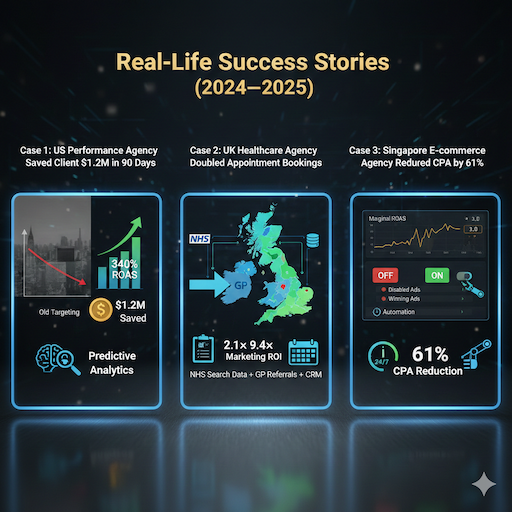
Real-Life Success Stories (2024–2025)
Case 1: US Performance Agency Saved Client $1.2 M in 90 Days
A New York agency used predictive analytics in marketing to target audiences that looked good on paper but never converted. They reallocated the budget to look-alike audiences built from high-LTV buyers. Result: 340% ROAS in 3 months.
Case 2: UK Healthcare Agency Doubled Appointment Bookings
By combining NHS search data + GP referral patterns + their own CRM, they built hyper-local campaigns that changed messaging by postcode. Marketing ROI measurement jumped from 2.1× to 9.4×.
Case 3: Singapore E-commerce Agency Reduced CPA by 61%
Used real-time marketing insights to turn off ads the moment marginal ROAS dropped below 3.0. Automation ran 24/7 — humans only reviewed winners.
How to Optimize Marketing Campaigns with Data Insights (Step-by-Step Playbook)
Follow this exact 8-step system top agencies use:
- Define crystal-clear KPIs (ROAS, LTV: CAC, pipeline velocity)
- Build or buy a unified data warehouse
- Create weekly marketing dashboards that every stakeholder actually reads
- Run weekly “insight → test” meeting (30 minutes max)
- Launch a minimum of 3 tests per channel per week
- Kill losers within 7–14 days (no emotion)
- Scale winners aggressively
- Document everything in a shared “Win Library”
Repeat forever.
Agentic AI + Data-Driven Marketing
Grammarly made a report in summer of 2025 about AI. It says AI tools for marketing are changing fast. From just helping people to doing the job all by themselves.
In 2026, many agencies will let AI:
- Choose how much money to spend
- Write different ads
- Stop campaigns on its own (but with safety rules).
→ Download the full Agentic AI in Marketing report here: Grammarly Business AI Trends Ebook2
Common Mistakes Agencies Still Make
- Trusting last-click attribution → Switch to data-driven or algorithmic attribution
- Looking at averages instead of segments → Always segment by country, device, and journey stage
- Waiting 30 days to make decisions → Move to 7-day decision cycles
- Ignoring offline conversions → Upload phone calls, form fills, and CRM data
FAQs
Can small agencies pay for data-driven marketing?
Yes! Small agencies can do it easily. Google Analytics 4 and Looker Studio are free. Other good tools cost less than $100 a month.
How long before I see good results?
Most agencies see much better numbers in just 3 months. That means 20% to 40% more sales or clicks after they set it up right.
Do I need a data expert?
No! New tools are super easy. No code needed. Normal marketers can do 80% of the work all by themselves with AI help.
Conclusion
The agencies that win in America, England, Canada, Australia, Germany, the UAE, Singapore, and all big countries do the same thing: They let the numbers decide, not just people’s ideas or feelings.
How agencies use data-driven insights for marketing strategies is no longer a “nice-to-have”. It is the only sustainable way to grow profitably in 2025 and beyond.
Your next step is simple: connect your data sources this week and run your first predictive report next week.