
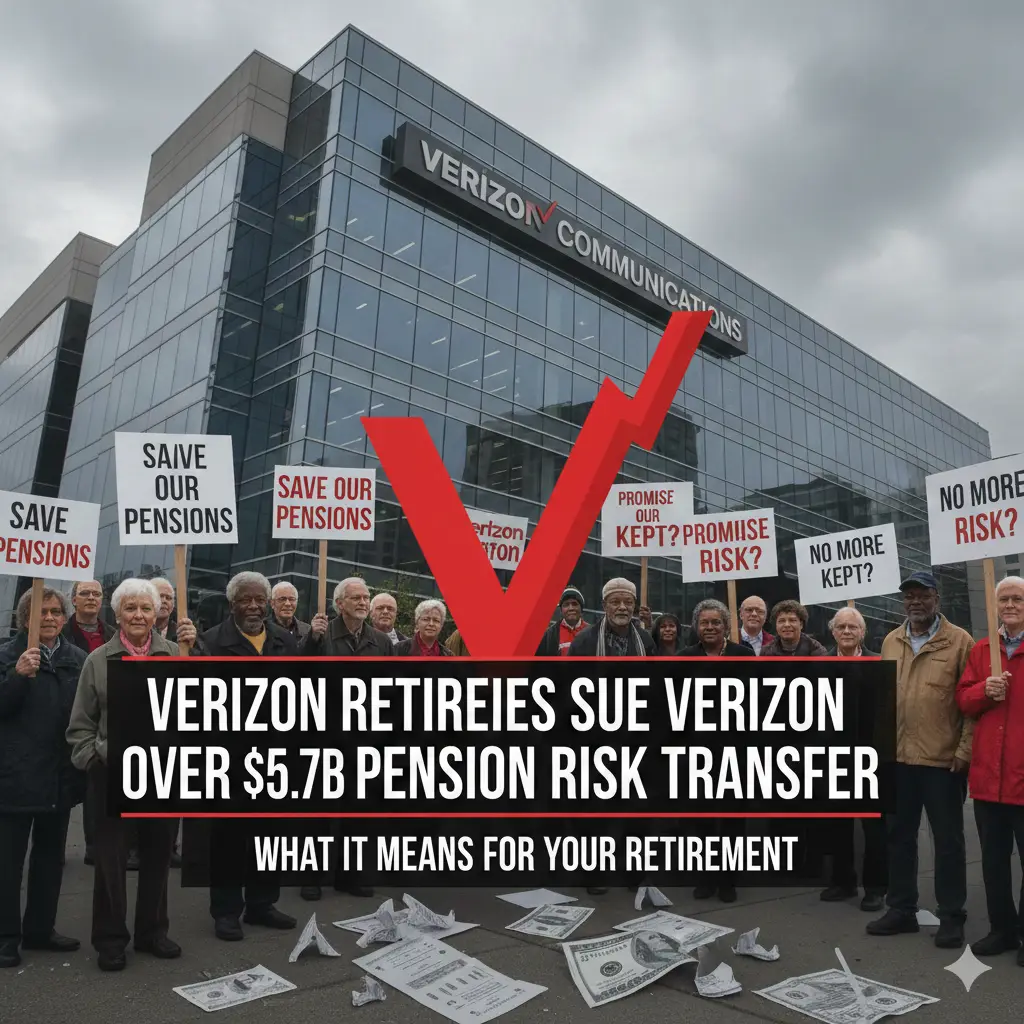
Verizon Retirees Sue Verizon Communications Over $5.7B Pension Risk Transfer: What It Means for Your Retirement
Imagine working hard for decades at a big company like Verizon. You earn a solid pension promise. Then, one day, that promise changes. Your benefits shift to an insurance company. You lose key safeguards. This is the story behind why Verizon retirees sue Verizon Communications over $5.7B pension risk transfer. Filed in late 2024, this lawsuit spotlights big worries for 56,000 retirees. It questions whether their hard-earned retirement security was traded for corporate savings. In this guide, we break it down simply. We cover what happened, why it matters, and tips to protect your future. If you’re a Verizon retiree or eyeing one at a similar firm, read on. Knowledge is your best tool.
What Is a Pension Risk Transfer?
Let’s start with the basics. A pension risk transfer (PRT) is when a company hands off its pension duties to an insurer. Think of it like passing a hot potato. The company pays the insurer a lump sum. In return, the insurer promises to pay retiree pensions. Sounds straightforward? Not always.
Companies like Verizon do this to cut costs and risks. High interest rates and strong markets in 2023-2024 made PRTs cheaper. But for retirees, it can mean less protection. Under the old setup, your pension falls under ERISA fiduciary duty—federal rules that guard your benefits. After a PRT, you’re often just a holder of a group annuity contract. State laws apply. No more federal backstop from the Pension Benefit Guaranty Corporation (PBGC).
Here’s why PRTs are booming:
- Corporate de-risking strategies help firms focus on core business, like Verizon’s 5G push.
- In 2023, U.S. PRT volume hit $35 billion, up from $25 billion in 2022 (per LIMRA data).
- By 2024, it topped $40 billion, with Verizon’s deal a big chunk.
But critics say it shifts risks to retirees. Pension risk management sounds smart for bosses. For you? It might mean thinner safety nets.
How $5.7 Billion in Pensions Moved
In March 2024, Verizon completed a massive PRT. It transferred $5.7 billion—some sources say $5.9 billion- in liabilities. This covered pensions for 56,000 retirees and beneficiaries from two plans:
- Verizon Management Pension Plan
- Verizon Pension Plan for Associates
The cash went to Prudential pension annuities and RGA Reinsurance Company involvement. Prudential handles most payments. RGA reinsures part of the risk. State Street Global Advisors (SSGA) acted as the “independent fiduciary.” They picked the insurers.
Verizon said it was a win. The deal freed up balance sheet space. It boosted stock focus. But retirees saw red flags. Their benefits left the ERISA umbrella. No PBGC insurance, which covers up to $7,000 monthly if a plan fails (2025 limit). Instead, they’re tied to insurers’ health.
Key timeline:
- Early 2023: Verizon eyes PRT amid rising rates.
- Late 2023: Deal announced.
- March 2024: Transfer closes.
- December 30, 2024: Lawsuit filed in U.S. District Court, Southern District of New York.
This isn’t Verizon’s first rodeo. In 2012, they did an $8.4 billion PRT to Prudential for 41,000 retirees. That sparked suits, too. One reached the Supreme Court. It was dismissed in 2016. History repeats?
Why Verizon Retirees Filed a Lawsuit Over the $5.7 Billion Pension Transfer
The suit, Dempsey et al. v. Verizon Communications Inc. et al., names Verizon, its benefits committee, plan sponsors, and SSGA. Lead plaintiffs: Maureen Dempsey (ex-engineer), Heinz E. Schlenkermann, and Chris Shelton. They represent all 56,000 affected.
Core claims? Verizon ERISA violation. Plaintiffs say the transfer breached fiduciary duties. It was “imprudent, disloyal, and prohibited.” Why? Verizon and SSGA allegedly picked the cheapest available annuities, not the safest available. U.S. Labor Department rules (Interpretive Bulletin 95-1) demand the safest.
Pension fund transfer dispute boils down to risks:
- Insurance-backed pension payments rely on Prudential and RGA’s stability. Both use affiliates in low-regulation spots like the Bahamas. Books aren’t fully clear.
- No deep dive into “captive reinsurers”—hidden risks from junk bonds or bad bets, like the 1980s Executive Life collapse (wiped out 84,000 pensions).
- SSGA holds stock in Verizon, Prudential, and RGA. Conflict? Plaintiffs say yes—self-interest over retirees.
Quote from the complaint: “The combination of unique risks… is contrary to the best interests of the impacted Verizon retirees and has resulted in less secure pension benefits.”
Relief sought:
- Reverse the transfer.
- Buy reinsurance to guarantee annuities.
- Put contracts back in the plan as assets.
- Cover legal fees.
Verizon calls it “without merit.” They’ll fight. Prudential defends: “These transactions safeguard retirees.” But for now, court battles loom.
Verizon Pension Lawsuit: Breaking Down the ERISA Claims
Verizon retirees’ legal action hinges on ERISA, the 1974 law shielding pensions. It sets the ERISA fiduciary duty: Act solely for the participants’ benefit. Prudent. Loyal. Diversified.
Plaintiffs argue four breaches:
- Failure to investigate risks: No full review of Prudential/RGA’s affiliate deals or asset exposure.
- Prohibited transactions: SSGA’s stock ties create conflicts.
- Loss of protections: Retirees ditched the PBGC backstop. State regs vary, some are weaker.
- Substandard choice: Cheaper annuities ignored safer options like Athene or MetLife.
Annuity pension transfer lawsuits like this test PRT limits. Past cases:
- Bristol-Myers Squibb (2024): Similar suit vs. SSGA over $2B PRT to Athene. Alleges hidden risks.
- General Electric (2010s): $26B PRT sparked ERISA fights. Some settled.
- Verizon’s 2012 suit: Class certified, but lost on appeal.
Stats show stakes:
- 10 million U.S. workers in defined-benefit plans (PBGC 2024).
- PRTs covered 1.2 million lives in 2023—double 2020.
- PBGC insured $500B+ in liabilities, but PRTs sidestep it.
If won, this could halt PRTs or force better checks. For retirees, it’s a wake-up.
Risks of Pension Risk Transfer to Insurance Companies: What Retirees Lose
Why do Verizon retirees file a lawsuit over the $5.7 billion pension transfer? Fear. The shift erodes security. Here’s what changes:
What retirees lose in a group annuity pension transfer:
- PBGC protection: Federal insurance up to limits. Gone. Insurer fails? State guaranty funds cap low—e.g., $100K lump sum in some states.
- ERISA rights: No federal court access for disputes. Sue under state contract law—tougher, costlier.
- Transparency: Plan assets were public-ish. Annuities? Opaque affiliate webs.
- Portability tweaks: Some benefits are harder to adjust for life changes.
How pension annuity transfer affects retiree protections under ERISA:
- Pre-PRT: Fiduciaries liable for mismanagement.
- Post: You’re a certificate holder. The insurer calls shots.
Real risks:
- Insurer insolvency: Executive Life (1991) cost workers big.
- Reinsurance chains: RGA’s captives in Barbados—hard to audit.
- Market hits: If assets tank, payments could lag.
Are annuity-based pensions safe after corporate risk transfers? Often, yes, insurers are strong. Prudential’s rating: A+ (AM Best). But “safe” isn’t “safest.” Plaintiffs say Verizon skipped that. For a secondary audience, like workers at IBM or Ford with DB plans, this is a warning. Ask: Has my firm eyed a PRT?
Impact of Removing PBGC Protection from Corporate Pensions
ThePension Benefit Guaranty Corporation (PBGC1) is your pension safety net. Created in 1974, it steps in if plans fail. Covers 95% of benefits, up to $7,000/month (2025).
In PRTs, that’s removed. Impact of removing PBGC protection from corporate pensions? Huge for vulnerable folks.
- Low earners hit hardest: PBGC caps protect basics. Annuities might not.
- Longevity risk: PBGC assumes average lifespans. Insurers do too—but no federal pool.
- Systemic worry: If multiple PRTs fail (recession?), no backstop strains states.
Data: PBGC paid $8B in 2024 benefits to 1M retirees. PRTs have grown 20% yearly since 2020. Trend? More offloads.
Retirement security concerns rise. AARP warns: PRTs save firms $10B yearly but shift $50B risk to individuals by 2030.
Tip for employees approaching retirement: Review your Summary Plan Description. Spot PRT talk? Dig in.
Legal Concerns Over Verizon’s Pension De-Risking Strategy
Legal concerns over Verizon’s pension de-risking strategy center on fiduciary lapses. ERISA demands a “prudent expert” process. Did Verizon pass?
- Selection flaws: SSGA reviewed 10+ bidders but picked Prudential/RGA without full affiliate data.
- Conflicts: SSGA’s $1B+ in Prudential stock? Red flag.
- Prohibited acts: Transfer seen as self-dealing, boosted Verizon’s credit rating, cut liabilities.
Broader: Corporate pension litigation surges. 15 PRT suits since 2023 (per DOL). Targets: SSGA (3x), Athene (4x).
For HR execs: Document everything. Pension rights advocacy groups like Pension Rights Center push DOL probes.
Regulators watch: DOL’s 2024 guidance eyes PRT transparency. SEC eyes insurer disclosures.
Consequences of Pension Liability Transfers on Retiree Benefits
Consequences of pension liability transfers on retiree benefits? Subtle but real.
Short-term:
- Payments continue, insurers honor contracts.
- No immediate cuts.
Long-term:
- Pension liability transfer locks benefits. Cost-of-living adjustments? Often frozen.
- Inheritance: Spousal/survivor benefits shift to annuity rules, less flexible.
- Taxes: Same, but state variations.
For 56,000 Verizon folks: Monthly checks from Prudential now. But if RGA stumbles? Delays.
Details of the Verizon pension risk transfer lawsuit 20232 (announced then, filed 2024): Alleges $200M overpay to insurers due to poor picks.
Pension fund transfer dispute echoes 401(k) fee suits, excess costs hurt nests.
Broader Trends: Corporate De-Risking and Retirement Security
Corporate de-risking strategies are everywhere. Verizon joins GE ($50B PRTs), Boeing ($20B). Why? DB plans cost $300B yearly (Milliman 2024).
Insurance-backed pension payments via PRTs: 60% of 2024 volume. Reinsurers like RGA handle 40%.
But reinsurance companies’ involvement adds layers. Captives in tax havens? Scrutiny up.
For institutional investors: Balance sheets look cleaner post-PRT. Verizon’s debt rating? Stable.
Employee retirement protections fray. Only 15% of private workers have DB plans (BLS 2024). PRTs speed the end.
Journalists’ note: This tests the U.S. retirement model. Shift to 401(k)s left gaps—PRTs widen them.
What This Means for Other Retirees and Companies
Secondary audience: Think AT&T or GM workers. Defined benefit pension legal case like Verizon’s? Your cue.
- Pension / benefits consultants: Stress “safest” in bids. Avoid conflicts.
- Plan fiduciaries: Audit affiliates. DOL fines hit $1M+ for breaches.
- Human-resources executives: Communicate early. Retiree trust erodes fast.
For insurers: Prudential pension annuities face heat. RGA too. Solvency ratios are strong (300%+), but lawsuits chill deals.
Policymakers: Bills float ERISA extensions to PRTs. Watch Congress.
Pension risk management evolves. Lump-sum windows offer outs—Verizon did $1B in 2023.
Tips to Protect Your Pension in Uncertain Times
You’re not powerless. Here’s actionable advice, broken down simply.
For Verizon retirees:
- Join the class: Contact Edward Stone Law if affected.
- Track payments: Set alerts for Prudential statements.
- Diversify: Use pension as base; build 401(k)/IRA buffers.
For workers with DB plans:
- Ask questions: “Any PRT plans?” at benefits meetings.
- Review docs: Check SPD for transfer clauses.
- Build emergency fund: Cover 6-12 months expenses.
- Consult pros: Free PBGC tools at pbgc.gov3.
General tips for retirement security:
- Delay Social Security to 70 for 8% yearly boost.
- Aim 15% savings rate.
- Use tools like why is personal finance dependent upon your behavior to tweak habits.
For fiduciaries/consultants:
- Run stress tests on insurers.
- Disclose conflicts upfront.
- Link to resources like DOL’s PRT guide.
These steps build resilience. Remember: Small actions now prevent big worries later.
Similar Cases: Lessons from Past Pension Fights
Corporate pension litigation isn’t new. Verizon’s echoes others.
- Lee v. Verizon (2012): 41,000 retirees sued over Prudential transfer. Class certified. The Supreme Court remanded. Dismissed, but set precedents.
- Pundt v. Verizon: Ongoing for remaining plan members. Standing fight.
- GE PRT suits: $26B to Athene. Alleges underfunding.
Common thread: ERISA fiduciary duty breaches. Wins are rare, but pressure mounts. Settlements average $10M.
For researchers: PRTs cut firm volatility 20% (Harvard study). But retiree anxiety? Up 30% post-transfer (AARP poll).
The Role of Reinsurance in Pension Deals
Reinsurance companies’ involvement is key. RGA takes Prudential’s overflow risk. Why? Spread bets.
But plaintiffs slam opacity. Captives hold illiquid assets, private equity, and junk bonds. Exposure? Unknown.
Stats: Reinsurance grew PRTs 50% since 2020. RGA’s book: $100B+.
Pension Benefit Guaranty Corporation (PBGC) skips this. No federal levy on annuities.
Tip: Read insurer filings. Prudential’s 10-K shows 15% captive reliance.
Voices from the Front Lines: Retiree Stories
Real talk: Maureen Dempsey, plaintiff, said in filings: “I trusted Verizon for 30 years. Now, my future hangs in hidden balance.”
Chris Shelton, ex-union leader: “This isn’t de-risking, it’s dumping.”
Advocates agree. Pension rights advocacy groups like NCP64 rally. They sued Verizon in 2012, lost, but fought.
Broader: 70% of DB retirees fear cuts (Transamerica 2024).
These stories humanize stats. Your pension? More than numbers.
Will PRTs Change?
Pension risk transfer lawsuit wave: 20+ since 2023. Verizon’s? First big vs. Prudential.
Impacts:
- Deals slow: Q4 2024 volume down 15% (LIMRA).
- Regs tighten: DOL eyes “safest” mandates.
- Alternatives rise: Enhanced lump sums, hybrid plans.
For institutional advisers: SSGA’s role questioned. Conflict disclosures up.
Optimist view: PRTs secure 90% of transfers (Moody’s). Pessimist: Erosion of employee retirement protections.
Watch 2025: Court rulings could pivot.
FAQs
What is the Verizon pension lawsuit about?
Old Verizon workers are mad and suing the company. Verizon gave its pensions (retirement money) to two big insurance companies in a $5.9 billion deal. Now the workers have lost their strong safety rules and feel tricked.
Will my Verizon pension money stop coming?
No! Right now, your checks keep coming every month — nothing changes today. You are safe for now. But if the insurance company ever has big money problems, your pension could be in danger because the super-strong government help is gone.
Can I join the lawsuit too?
This lawsuit is for about 56,000 old managers whose pensions were moved in 2024. Go to the website edwardstonelaw.com and fill out the little form. The lawyers will tell you for free if you can join. Do it quickly!
Are all these pension moves bad?
No, not all of them are bad. Some companies do it the safe way and pick the very best insurance. The problem here is that the workers say Verizon picked the cheapest one instead of the safest one and hid the dangers. Always ask to see everything and say, “Show me the safest choice!”
What is PBGC?
PBGC is like a government superhero safety net. If your company ever can’t pay your pension, PBGC steps in and saves most of your money. After Verizon’s deal, that superhero safety net disappeared forever. Now there is only a smaller, weaker safety from each state.
Conclusion
The verizon retirees sue verizon communications over $5.7b pension risk transfer saga underscores a harsh truth: Retirement promises can shift. This $5.7 billion deal freed Verizon but left 56,000 retirees exposed—sans ERISA shields, PBGC nets, and full transparency. It’s a stark case of corporate de-risking strategies clashing with retirement security concerns. Yet, hope glimmers. Lawsuits push accountability. Regs evolve. You hold power: Stay informed, diversify, advocate.
Key takeaways:
- PRTs save firms but test retiree trust.
- Fiduciaries must pick the safest, not cheapest.
- Broader: U.S. pensions need modern guards.
For Verizon folks or peers at big firms, this is your signal. Review plans. Build buffers. Secure what you’ve earned.